
Sunny and Existential
with a strong chance of underpants

My brain has been a loosey-goosey plate of scrambled eggs for the last few days, seasoned with a dusting of depression. Even I, with my inexplicable (contrarian?) well of cheer, my war-baby coping mechanisms, have days where I wake up, take in the scale of pain and destruction happening across the globe—most of which my own adopted country is inflicting—and wonder if it will ever stop. I wonder if we are ever going to feel OK again.
My self-soothing instinct is to compare fear and danger. In my quiet house in sunny Los Angeles, I am fearful of what could happen, but I am not currently, today, in physical danger. But but but… says my worry brain, and I shush her. “Could” opens a destabilizing can of worms. Be here now, I tell her.
Being here, now, means receiving an email for a service that I definitely didn’t sign up for. “Once you have activated your account you will be able to submit a record application to Guinness World Records…” it says, and I holler at the kids in the next room. They say they’re trying to break a record, and that we have to be registered on the site to submit one. I guess this is why they just asked for my birth year. I don’t have the energy to fight whatever is going on, so I putter around the kitchen, doing end-of-day things, the things that I am grateful for keeping existential spirals in check.
The seven-year-old runs in holding her sneakers, breathlessly asking where the kitchen timer is. She wants to beat the world shoe-tying record, which she claims is 30 seconds. 30 seconds is kind of a long time to tie your laces, I point out. My son bursts in to read the actual record aloud. It says right here: 30 seconds to lace a pair of shoes. I explain what the difference is—I wonder momentarily how they’ve never seen an unlaced pair of shoes—but they are only minimally deterred.
As they run off to make an adjustment, my mind wanders back to the news. I’ve written before about how living in America is like holding a lottery ticket to the one place in the world that America won’t bomb. But I need to adjust this framework. I spoke to a woman recently whose parents died in a horrible accident when she was a teen. Of course, it’s nothing like what you’ve gone through, she quickly said, because she’d read my memoir. Not to compare, I said, but your story sounds much harder. I still have my family. She looked a little confused, and it took me a while to understand why. It was because her own self-soothing instinct, the one that tries to convince her it wasn’t so bad, that she’s OK, presupposes that the areas of the world in which I experienced my pain — India and Saudi Arabia mostly— are places “less fortunate.”
As I go through my fear vs. danger exercise, aren’t I doing the same thing? Soothing myself with touchstones of my own great fortune, and comparing it to the fortune of others, far away, where I used to be, where the violence is happening? And ultimately, what do I know of fortune? I can tell you that thousands of people that have died by our hands in the last year had sharper minds, sweeter love, more laughter, better meals in their lives than I’ll ever know. Is that not also fortune? By any definition, my place in the social fabric is no more about fortune than a schoolyard bully and his gang are fortunate, and the victim of a beating less so.
Without the framework of relative fortune—are we more fortunate, under the watchful eye of what seems to be a depraved, fathomless criminal syndicate?— I struggle to define how grateful I feel to be here, now. We—hundreds of millions of Americans—have watched the bloom on this rose fade, in record time. The realization of how this country actually operates has been a necessary education, but that doesn’t make it less painful. But a nation can’t go back to not knowing, so what would it even look like, to feel OK again?
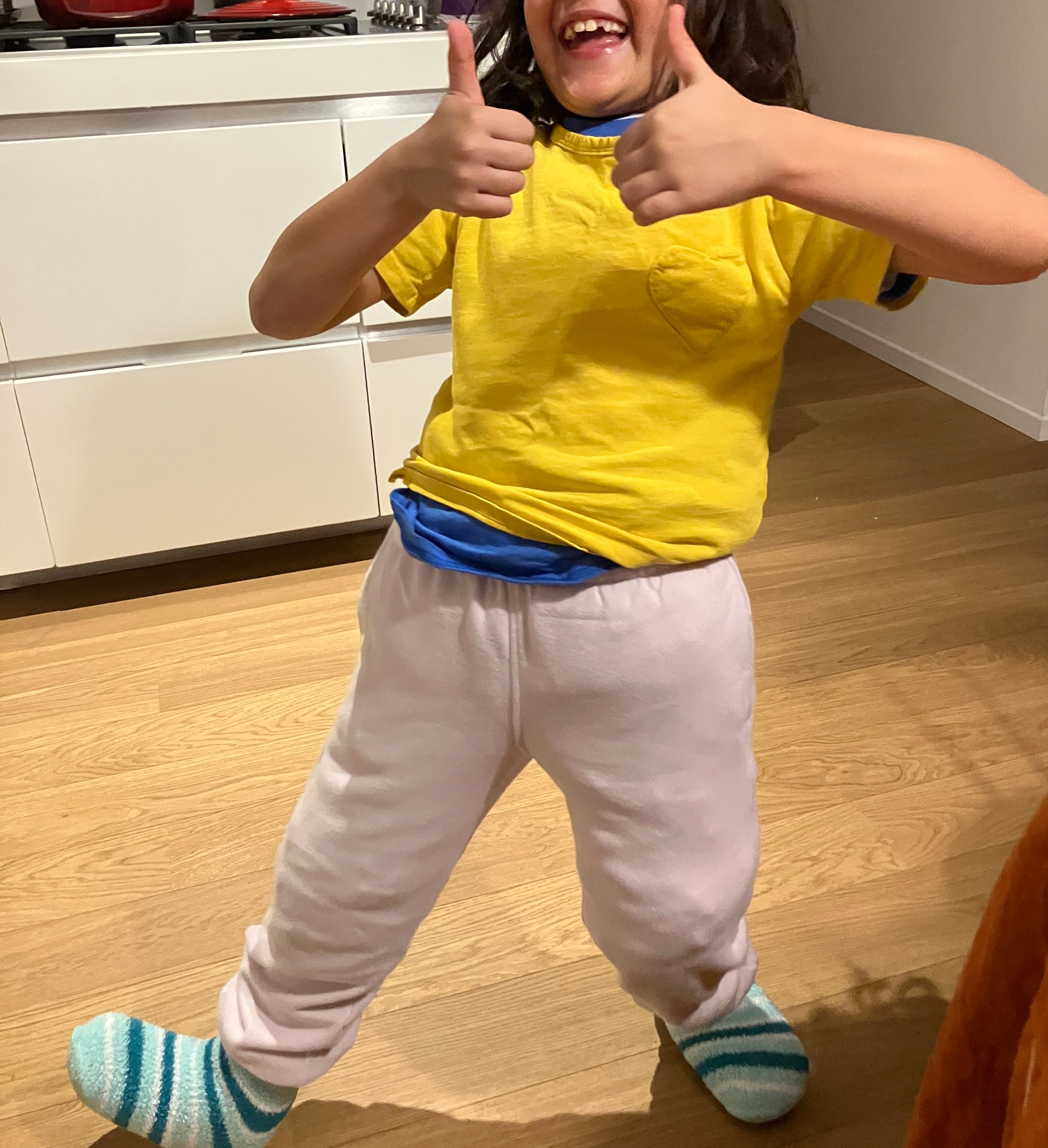
As my husband tidies up the kitchen and I’m writing up the family schedule for the week, our daughter waddles in wearing six pairs of pants, four shirts, and 12 pairs of socks. “They feel like Uggs,” she says, slipping all over the place as she leaves.
I know, watching her, what I actually mean to compare. It’s not fortune. It’s our sense of safety. Physical, emotional safety, and freedom from fear. I want safety for ourselves, for everyone in this country, for every person in the world. I don’t have a plan to make this happen—it’s extremely eldest daughter to feel like I’ve somehow failed in not fixing this yet. But I think there is a reason I am informing myself about every little neighborhood meeting, throwing myself into the community, helping my friend Faizah run for city council. I work on making my home relatively safe. In concert with others who feel like me, I can help make the neighborhood relatively safe. I can assume that every citizen of every neighborhood in every place wants the same, and hope we move toward leadership that shares our goals.
The kids are still busy rifling through their closets, so my husband and I move on to sit relatively peacefully in the living room—he with a book, me with some yarn. My son walks in wearing eight pairs of underpants. My daughter follows him, giggling, wearing thirteen. I don’t know what this record is, or why it exists. “This is exactly what’s supposed to be happening,” says my husband, looking up from his book, as they scurry off again. I get back to knitting a big orange hat.
More soon. x
I just love your writing.
What a lovely piece. Thank you for sharing! I’ve been thinking a lot about a quote (I think from a Palestinian activist) that was framed by a Minnesotan activist. The Minnesotan relayed the chemicals deployed against protestors here stung their skin in a very unique way, and the Palestinian activist said something like, “yes, those are the same ones they use on us.” The violence is so pervasive and overwhelming and related, knit from the same cloth.