
We Need to Talk About Michael
on big, unfinished conversations

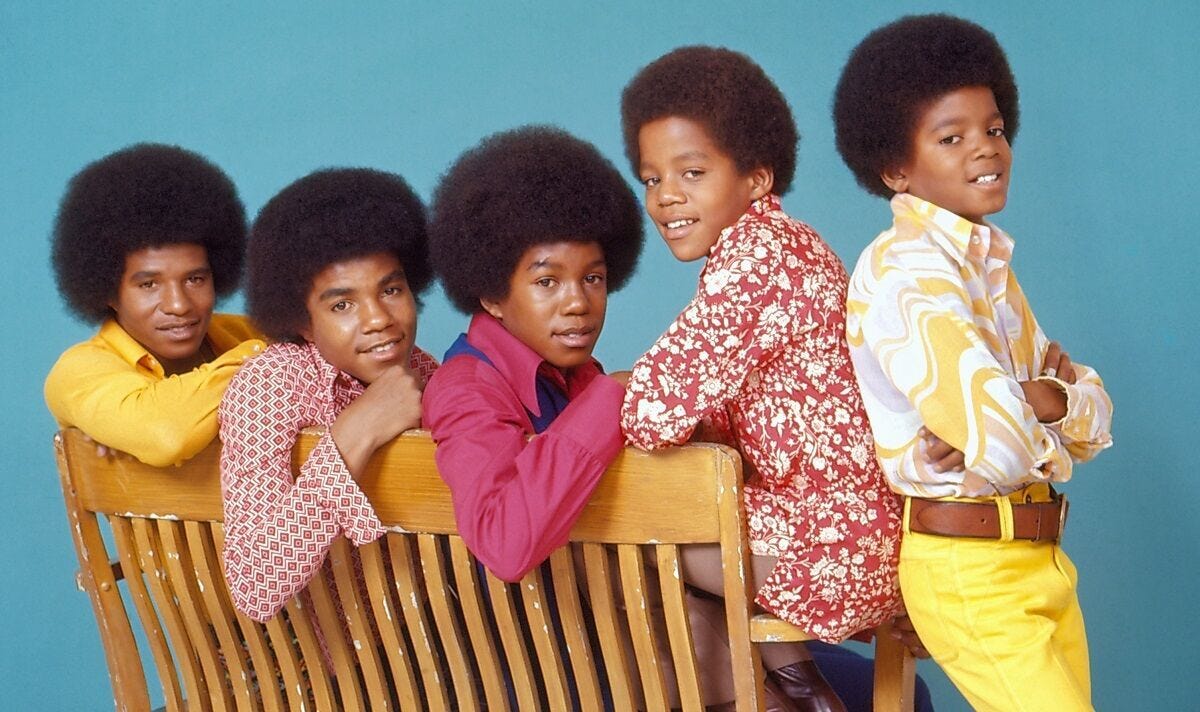
I was washing dishes last week when my son asked if he could go see Michael, the Michael Jackson biopic currently in theaters. With my back toward him, I could mask my flustered response. What was I supposed to say? A casual “…Sure?” Or “No, because…?” Or was it more of a “Yes, but…”
But what? What context was even developmentally appropriate to share with a tween? The rule of thumb, echoed by the pediatricians and educators in our lives, is to give kids the simplest answers to their complicated questions, and no more. But he’s no longer a baby, and the internet will reveal the whole truth to him in time. In a short time, I’ve learned from recent experience. Wouldn’t it be irresponsible not to tell him first?
Whatever I was meant to say, I was not going to figure it out in that moment at the sink, so I dried my hands, distracted, and said we’d talk about it closer to the weekend. That bought me a few days to think.
***
I remember bursting into tears when I heard Jackson died, in the summer of 2009, and it wasn’t because of any specific emotional connection to him, or his music. I was a Hollywood agent at the time, working closely with people who were wildly famous, and it had given me direct insight into the diamond-encrusted prison of celebrity. I had come to regard fame with a mix of pity and horror, and rivers of both came tumbling out the week of his death.
The jaws of fame had taken a tiny little boy with otherworldly talent and turned him into a gnarled, decaying entertainment machine. He was surrounded by a complex apparatus that likely enabled him to destroy other young lives, as his own had been destroyed. His life was a multi-layered, expansive tragedy of Homeric proportions, and we’re still discovering all of its characters and story lines.
I was blubbering on the phone with my mother that day. We did this to him, I said, crying, haunted by his shining little six-year-old face. He never had a chance to be to be normal. This wasn’t a conversation I could have with my son, though, who spent the rest of last week playing Michael Jackson hits in the car, while his sister boogied along in the back seat. I drove them around with a tight smile, mind whirring.
The historical timeline is littered with brilliant men who destroyed lives. Claire Dederer said more than I could ever say about this in her brilliant book, Monsters: A Fan’s Dilemma, which investigates whether it’s possible to separate art from artist-monster. But to me, the Michael Jackson question isn’t about separating art from artist, because I don’t know if that’s even possible. He burst into the world singing and dancing, and under four feet tall. He left, tortured, in sort of the same way. He was the art, and the artist.
He had a complicated life, I said the next time my son brought up buying a ticket to the movie. He interrupted me to tell me that he had heard rumblings at school about the raft of allegations against Jackson, and all of the assorted weirdness, and we talked through all of it, in a way that I hope didn’t traumatize him forever. I guess we’ll find out in ten or fifteen years.
But every kid I know absolutely loves the music. He’s since seen the film, and he loved that too. A whole bunch of people got up to dance in front of the screen during “Wanna be Starting Something,” and it made his week. We live in a quadrant of LA that’s primarily black and brown, and it’s turned out in droves to support the film, which has so far made $424m worldwide, on a reported budget of $150m.
This experience, the liveliness of that theater, make me think of a TV moment that echoes in my head on loop: Kendrick Lamar accepting a Grammy in 2025, for “They Not Like Us.” He’s a man of few public words, but I always remember these one: “We are the culture,” he says, to a room full of “They,” and everyone recognizes this as the stone cold truth.
Michael Jackson was the culture. He still is the culture, to every kid who hears “ABC” or “Beat it” for the first time and doesn’t need to be encouraged to dance, doesn’t need an explanation of why they’re some of the greatest songs of all time. To deny the significance of Michael Jackson’s advancements in pop music would be to deny that Alexander Graham Bell—noted eugenicist, hater of deaf people—invented the telephone, or to deny that Gandhi—habitual wife-beater—galvanized the movement for Indian Independence.
My son says I should watch the movie with him when it shows up on streaming, that as a kid of the 80s it might speak to my nostalgia. I smile and change the subject, and don’t tell him what I’m really thinking: That I can appreciate Jackson’s contributions, but I’m no longer able to enjoy them.
More soon. x
If you enjoyed this newsletter, don’t be too shy to “like” or comment. Feel free to share it with other people, subscribe, and/or pre-order my upcoming book How to Be Less Useful.
"...That I can appreciate Jackson’s contributions, but I’m no longer able to enjoy them." - you so perfectly summed up my feelings and put them into the words I had not yet formed. Thx!
Elegantly put, yes.